 Dr. McLellan’s lab is focused on solving ocular problems that affect animals and humans, with a particular emphasis on glaucoma. Her lab is uniquely positioned to apply the principles of “One Health” to vision research with strong collaborative relationships that exist between her laboratory, other members of the vision research community and clinical veterinary and physician colleagues. Though a major focus of her work is on understanding how a particular gene mutation affects eye development early in life, with the goal of helping children and animals with congenital glaucoma, the McLellan lab is conducting studies in a broad range of other important areas related to eye and brain health.
Improving Ophthalmic Diagnostic Tests in veterinary patients and people
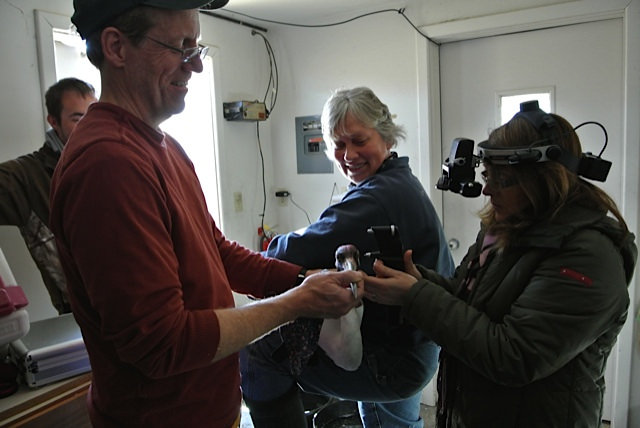
Our lab has helped develop a range of exciting new imaging techniques to help with diagnosis and treatment planning in dogs and cats with glaucoma and this knowledge has even been applied by our physician colleagues to gain important insight into underlying pathology in children with glaucoma. Our lab is at the forefront of development and validation of improved methods for measuring eye pressure in animals.
Humans, dogs and cats are not the only species kept as pets. As more and more people share their lives with less conventional species, there is a need to improve understanding of both eye diseases and normal ocular features of these critters. Our lab has assessed methods for measuring intraocular pressure in a range of species from turtles to chinchillas and has collaborated with zoo veterinarians to establish normal ranges of intraocular pressure in a wide range of species!
Initial Steps Towards Reducing Glaucoma Incidence in Dogs
 Veterinary Ophthalmologists and dog owners and breeders rightly fear glaucoma in their canine patients and companions. Glaucoma in dogs is a formidable adversary, that often causes severe pain and can rob affected dogs of sight in a matter of hours. In this respect, the disease in dogs most resembles acute angle closure glaucoma in people. While medical and surgical advances enable us to preserve vision in some of our canine glaucoma patients for months or even years, these treatments do have high complication rates. A range of dog breeds are over-represented in our clinical glaucoma caseload at UW Veterinary Care and we are actively working to help discover and understand genes responsible for susceptibility to glaucoma in several breeds including the Siberian Husky, Entlebucher Mountain Dog, and Basset Hound. We currently collaborate with veterinarians and scientists at the University of Wisconsin-Madison dog breeders, breed clubs and several veterinary ophthalmologists throughout the USA, Europe, and the UK, as well as leveraging the unique resources maintained by our colleagues in the Comparative Ocular Pathology Laboratory of Wisconsin (COPLOW). Learn more about glaucoma in dogs here.
Our studies have been generously funded by grants from the Vision for Animals Foundation; the Canine Health Foundation (American Kennel Club); the Marfan Foundation, and UW-Madison’s Companion Animal Fund.
New Treatments for Cats with Glaucoma
Work in our lab has evaluated a large number of existing treatments for glaucoma in cats, but results of these studies were disappointing until we recently identified a very promising and much needed treatment for glaucoma in cats. We are currently working to develop improved ways to deliver the treatment to the eyes of affected cats, to reduce the need for frequent application of eye drops. These new methods and formulations could also have important, broader implications for treatment of glaucoma as well as other eye diseases in people and animals.
Feline Herpesvirus-1: Finding New Weak Spots in the Common Virus that Causes Debilitating Disease in Cats
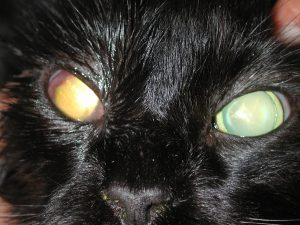 Unlike glaucoma which is not a frequently diagnosed disease in general veterinary practice in cats, Feline herpesvirus-1 is an extremely widespread infectious cause of painful and debilitating eye and respiratory disease in cats and is a major health problem encountered in cats in animal shelters in the USA and worldwide. In severely affected cats, anti-viral medications can be used but these vary in their effectiveness and safety, and response to treatment can be difficult to predict in individual patients. Dr. McLellan conducted an in-depth, state-of-the-art genetic study of this troublesome virus. Working together with a team of colleagues and collaborators, including internationally recognized virologists; a veterinary ophthalmologist, and Shelter Veterinarians throughout the USA, our goal was to determine the genetic makeup of different strains of Feline herpesvirus-1 isolated from cats with eye and respiratory disease. Work is ongoing to determine if differences in the DNA of virus strains may account for variation in clinical severity of disease or response to anti-viral medications. Better understanding of this virus at a genetic level will enable the future development of more effective prevention and treatment measures, to limit illness, pain and discomfort in the cat population at large. This important work was supported by the School of Veterinary Medicine’s Companion Animal Fund.
Dementia in the Aging Population and its Intersection with Eye Health
Dr. McLellan and her lab team, in collaboration with other UW-Madison investigators, are actively researching the pathology that underlies cognitive decline in elderly cats, and its similarities to the brain changes that can result in dementia in people with Alzheimer’s disease and related diseases. Our goal is to develop better diagnostic tests to enable earlier diagnosis and possible treatment to delay onset of life-limiting dementia in elderly cats. If you have a cat over 12 years of age and would be interest in contributing to our study, learn more here.
We have also recognized brain changes occurring in cats and mice with glaucoma that we have shown has the potential to intensify and speed up behavioral decline in a mouse model of Alzheimer’s disease. These studies have important implications for elderly people at risk of both Alzheimer’s and glaucoma and highlight the importance of regular eye exams in the aging population, as it is possible that undiagnosed / untreated glaucoma could substantially reduce quality of life and life span in individuals with Alzheimer’s Disease.